

North Carolina Math Resources
Table of Contents
Curriculum Engine Access
We have setup a DEMO district on the Curriculum Engine called North Carolina Textbook Adoption.
Access information is listed under Logins.
Here is a link to help documentation on previewing a course: Course Manager | How to preview a course
Reviewing the NC Math Resources
Use the logins you have been provided to accees the North Carolina course materials online at CurriculumEngine.com
Below are a few brief videos that highlight accessing the course materials and running reports.
You can access additional help documentation and training videos on our Knowledge Base.
North Carolina Course PDFs
Course Details and Sample Lessons
| North Carolina | |
| Alignment | Examples: Each lesson in the North Carolina Math 1, 2, 3 & 4 programs was written specifically to address the NC Standard Course of Study. The Standards Correlations document in the Program Overview of each course provides a comprehensive list mapping the lessons to the NC Math 1, 2, 3 & 4 standards. Each course employs a problem-based model of instruction that supports and reinforces the eight Standards of Mathematical Practice (SMP). |
| Focus | The Walch alignment document shows that all major and supporting standards for the NC Standard Course of Study have been addressed. The practice standards are taught throughout the program. |
| Coherence | The alignment of this series to the NC Math 1, 2, 3 & 4 suggested unpacking documents assures the connections between domains, clusters, units, and courses have been addressed. Each lesson intentionally relates new concepts to students’ prior knowledge, setting the foundation for future learning and allowing access to prior learning. |
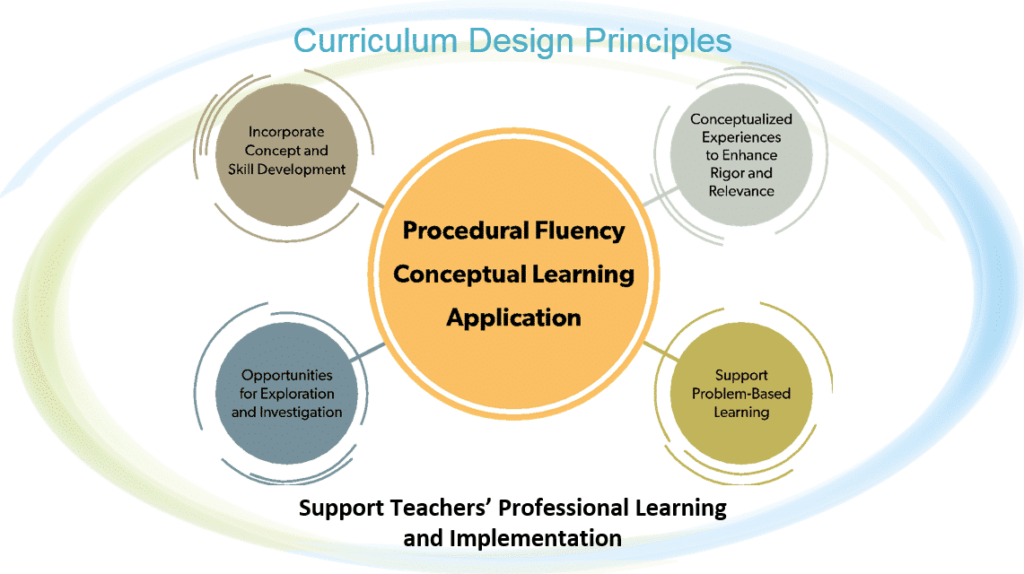
| Rigor and Balance | The NC Math 1, 2, 3 & 4 resources provide ample opportunities for students to practice fluency and procedural skills with our scaffolded practice, guided practice, and practice problems by providing students flexibility in their use of procedures and skills to solve problems. These course materials also provide opportunities for building conceptual understanding through our alignment of conceptual activities, which include Desmos and GeoGebra activities and other OERs. Aligned conceptual activities and conceptual tasks can be found listed in the Table of Contents and are accessible in the Curriculum Engine as learning objects. Problem-based tasks provide deeper understanding and integration of conceptual understanding in real-world applications by giving students the opportunity to access concepts and ideas from a variety of perspectives. |
| Equity and Differentiation | Instructional strategies assist teachers in delivering instruction for ALL learners and learning modalities are provided for every lesson, with explicit instructions and suggestions for struggling readers, ELLs, and students with disabilities in the Program Overview. Conceptual activities, found in every unit, address multiple learning styles. We provide a set of Coaching Questions for each problem-based task, which provides scaffolding, differentiation, remediation, and enrichment for all learners. We provide a set of scaffolded practice for each lesson, which provides a DOK 1 & 2 level set of problems. Performance Tasks are included in select units, and the problem-based tasks are found in every lesson. Conceptual activities can also be opportunities for listening, speaking, reading, and writing mathematics content. Problem-based tasks, as well as practices, warm-ups, and guided practice, incorporate diverse protagonist names and real-world examples throughout the program. |
| Other Considerations | |
| Assessment Materials | All test items are aligned to the NC Math 1, 2, 3 & 4 standards. We provide 10 interactive TEI formative practice problems per lesson, and each unit has a mid-unit assessments and unit assessment. Every attempt is made to align all test and practice items not only to the standard but the unpacking documents as well. Our items have been reviewed by educators. More than 20% of these instructional materials include TEI in both the assessments and the interactive worksheets. The problem-based tasks provide opportunities for students to engage in mathematical discourse and critical thinking. Our assessments have well over 13 different item types and also include the Desmos calculator. The aligned Desmos activities provide an opportunity for students to access learning through conceptual experiences and also for the teacher to gather formative data. |
| Curriculum Materials | Our Scope and Sequence follows very closely to what is specified by NC Math 1, 2, 3 & 4 standards. The Teacher Resource Book provides everything a teacher needs to facilitate each lesson and unit in one location. All curriculum materials are available in both digital and print format. |
| Student Materials | The student materials include a student workbook that consists of the following lesson and unit components: warm-up, guided practice, scaffolded practice, problem-based tasks, and two sets of practice problems. Students can also access these components and more on the Curriculum Engine. |
| Teacher Materials | Each lesson offers multiple alternative strategies and approaches. Problem-based and performance tasks include coaching to address the full range of DOK and various degrees of language proficiency. These course materials provide an opportunity for building conceptual understanding through our alignment of conceptual activities, which include Desmos activities and OERs. Common errors and misconceptions are highlighted throughout the Introduction and Key Concepts sections in every lesson, as are contextual step-by-step directions in the Guided Practice. |
–
| WAL1000 NC Foundations | WAL1000 NC Foundations |
|---|---|
| Course Overview | |
| Unit 2: Linear Functions | |
| Lesson 2.5: Determining the intercepts of the linear function |
Problem-Based Task Problem-Based Task: Coaching Questions Problem-Based Task: Coaching Sample Responses Practice Problems: |
| Lesson 2.13: Creating equations from Context (A-CED.2) | Problem-Based Task Problem-Based Task: Coaching Questions Problem-Based Task: Coaching Sample Responses Practice Problems |
| Additional Resources | Conceptual Task #1 |
| WAL1100 NC Math 1 Resources | WAL1100 NC Math 1 Links |
|---|---|
| Course Overview | |
| Unit 7: Polynomial Operations and Quadratic Functions | |
| Lesson 7.9: Interpreting Various Forms of Quadratic Functions | Problem-Based Task Problem-Based Task: Coaching Questions Problem-Based Task: Coaching Sample Responses Practice Problems: |
| Lesson 7.13: Comparing Models | Problem-Based Task Problem-Based Task: Coaching Questions Problem-Based Task: Coaching Sample Responses Practice Problems |
| Additional Resources | Conceptual Task #1 Conceptual Task #2 |
| WAL1104 NC Math 2 Resources | WAL1104 NC Math 2 Links |
|---|---|
| Course Overview | |
| Unit 1: Transformations | |
| Lesson 1.4: Proving Theorems About Isosceles Triangles | Problem-Based Task Problem-Based Task: Coaching Questions Problem-Based Task: Coaching Sample Responses Problem-Based Task: Implementaiton Guide Practice Problems: |
| Lesson 1.15: Triangle Congruency | Problem-Based Task Problem-Based Task: Coaching Questions Problem-Based Task: Coaching Sample Responses Problem-Based Task: Coaching Implementation Guide Practice Problems |
| Additional Resources | Conceptual Task #1 Triangulating a Waterspout Part 1 Triangulating a Waterspout Part 2 Conceptual Task #2 |
| WAL1104 NC Math 3 Resources | WAL1104 NC Math 3 Links |
|---|---|
| Course Overview | |
| Unit 6: Rational Functions | |
| Lesson 6.2: Graphing Rational Functions and Identifying Key Features | Problem-Based Task Problem-Based Task: Coaching Questions Problem-Based Task: Coaching Sample Responses Practice Problems: |
| Lesson 6.8: Creating Rational Equations | Problem-Based Task Problem-Based Task: Coaching Questions Problem-Based Task: Coaching Sample Responses Problem-Based Task: Coaching Implementation Guide Practice Problems |
| Additional Resources | Conceptual Task #1 Rationalizing Rational Functions Part 1 Rationalizing Rational Functions Part 2 Conceptual Task #2 |
